
3GPP based Fixed Wireless Access (FWA) has been around for nearly two decades, starting originally with 3G, then 4G and now on 5G. However, it has only been in the past 5 years, with the introduction of 5G, where we have seen an explosive growth across multiple regions. The growth of 5G FWA was also accelerated as a consequence of the global COVID-19 pandemic and the increasing importance of great broadband connectivity to the home.
3GPP Fixed Wireless solutions can be subdivided in many dimensions:
- Radio technology (3G vs 4G vs 5G)
- Frequencies used (e.g. Sub6GHz vs mmWave)
- Chipset capabilities (e.g. LTE device categories or number of 5G NR Carrier aggregations supported)
However, the most fundamental subdivision currently is:
- Indoor device or Outdoor device
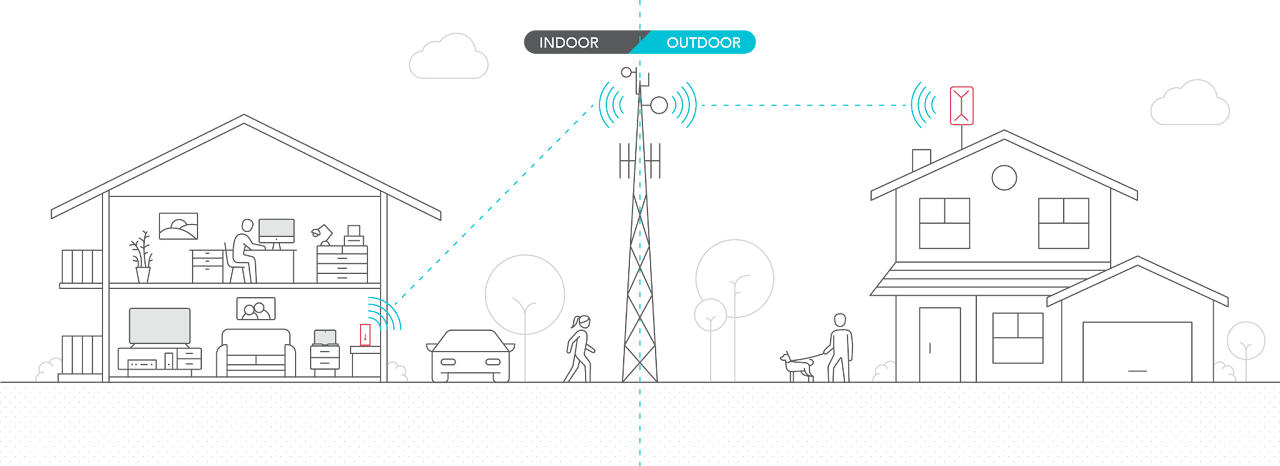
While both indoor and outdoor FWA have been around for a long time, the recent explosive growth has mainly been in Indoor offerings.
However, this is now shifting toward Outdoor devices as improved reach and performance accelerate deployments and, in turn, transform the overall economics of FWA.
Why Indoor FWA paved the way for early adoption…
Fixed Wireless offerings based on Indoor devices (typically with Wi-Fi AP integrated into the same unit) offer the path of least resistance to getting an FWA solution to the market for most mobile carriers. A single device, self-installed by the end user (often collected in-person from the mobile carrier's retail shop or sent in the post after ordering over the Internet) follows a familiar fulfilment process for mobile carriers and customers i.e. it's identical to the process for connecting a new customer to a smartphone today. No investment in a field force was required, customer fulfilment was quick, and to the end customer it was a very simple proposition.
Following this simple indoor connectivity model, the number of connected FWA users has surpassed all the original marketing forecasts, and most carrier's marketing departments have been more than satisfied with their progress and market penetration.
Why the shift to Outdoor FWA?
Indoor FWA devices are essentially not much different to your smartphones – both have a mobile chipset and some antennas. The main difference is that your smartphone has a battery (and a screen) whereas an Indoor FWA device is powered by AC and has larger antennas.
While cellular/mobile networks are improving every day, most users have encountered issues at times where smartphone indoor reception was far from ideal. For example, when a user can only achieve a single bar on their phone, the solution is often to walk to the nearest window or go outside. Why? The answer is simple – radio waves find it easier to travel through the air than they do through walls or windows. The higher the frequency of the radio wave (and typically 5G high bandwidth signals are at higher frequencies than traditional cellular signals) the harder it is to travel through solid substances. The result is that the signal received by the device is significantly reduced in strength after coming inside the building. We call this "attenuation" or "penetration-loss".
The larger and more numerous antennas in the indoor FWA device partially compensate for this attenuation, but aesthetic constraints on a device that needs to be visible inside the home place practical limits on how large these antennas can be.
Now let's explore why is this important. Imagine being in a large room and wanting to speak to a friend on the other side of the room. Shouting can get your message across easily as your friend will be hearing your voice at loud volumes (higher power). Now imagine you start to lower your voice, at some point in time after lowering the volume, your friend starts to have problems understanding you. You may need to repeat yourself or talk slower. In either case, it takes longer to get your message across.
This is exactly what happens in a cellular/mobile network. Devices which can listen to the network at high power levels can receive the data easily, without retries. But devices which are having to contend with lower power levels of the signal require the network to talk slower and to attempt to send the same information multiple times. The result is that the network becomes less efficient. For example, while you may eventually download a movie over your FWA device with poor signal strength, your FWA device is consuming network resources which could have been used for one of your neighbours.
With the cost of spectrum for the cellular/mobile carriers being very expensive (from millions to billions of dollars), the efficiency of the radio network to support thousands of end users, multiple device types, and multiple service types simultaneously, is key.
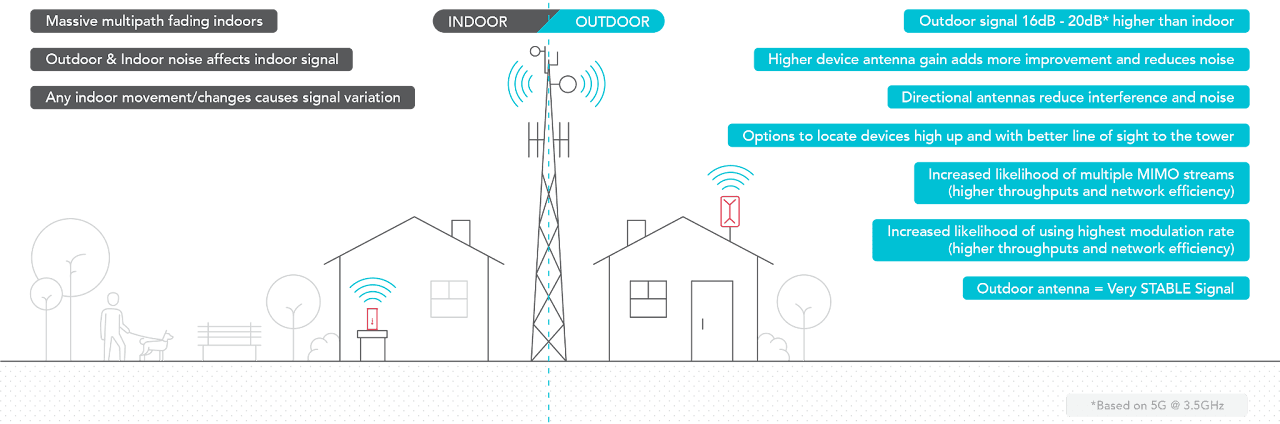
Shifting to Outdoor – the next wave of FWA optimization and monetization
Now that many carriers have met (or indeed exceeded) their original planning estimates for how many FWA customers they could support on their network using lower efficiency indoor devices, we see carriers starting to add outdoor devices to their portfolio.
This addition brings two vital benefits by enabling:
- A greater number of customers to be connected to the same cell tower while still receiving acceptable performance; and
- An expansion of the addressable market by allowing customers who are further away from the tower to be connected.
Clearly, both impacts drive increased revenues and monetization for the carriers, deliver more efficient use of their network and hence greater ROI. They also contribute to happier, consistently connected customers. It's a win-win situation for carriers and end users alike, and a change destined to be the next big evolutionary trend in FWA.
Outdoor solutions
When shifting to outdoor FWA solutions, carriers have a choice in approach:
- They can go with a Self-Install Outdoor solution using small devices and simple DIY mounting, or
- They can go with high-performing technician-installed devices mounted high up on a building.
Note that these two approaches are NOT mutually exclusive, carriers can use both solutions for different market segments. Self-Install solutions are a relatively new device segment whereas technician installed solutions have been deployed for over the past two decades.
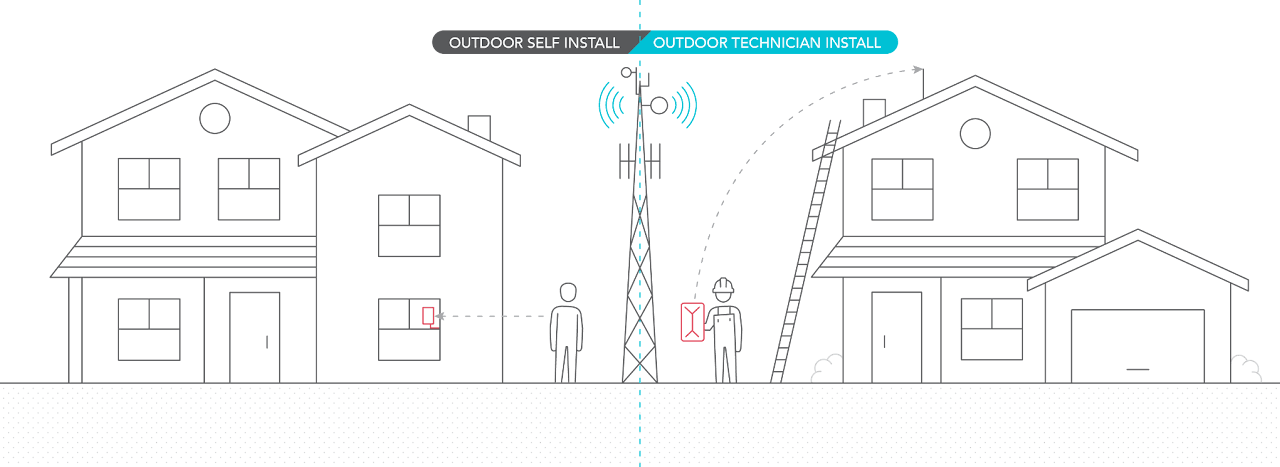
The pros and cons of each solution can be summarised as:
Self-installed Outdoor FWA
Pros:
- Better service: With no indoor attenuation, outdoor FWA delivers a much stronger end-to-end radio connection than indoor devices.
- Greater reach: The stronger outdoor signal enables carriers to serve customers farther from the tower, expanding the addressable market.
- Sales process: Customer fulfillment timelines and process are comparable to an indoor FWA offering.
- No truck roll: Unlike technician-installed FWA, these outdoor benefits are provided without incurring truck-roll costs.
Cons:
- Small Device: Self-Install Outdoor FWA devices typically must be small and easy to install by any end user. This typically leads to devices which do not require complex alignment and have comparatively small antennas, resulting in lower antenna performance compared to Technician Installed Outdoor devices.
Technician-installed Outdoor FWA
Pros:
- Best service: These devices are larger and use more directional antennas, delivering a significantly stronger end-to-end connection than both self-install outdoor and indoor FWA units.
- Extensive reach: Mounted high on a wall or roof, they benefit from improved line-of-sight (or near line-of-sight), providing better signal quality and greater range than self-install outdoor or indoor FWA units.
- Guaranteed performance: Because the carrier plans and installs the device, it can offer SLA-based service with confidence in the achievable performance at that location.
- Stickier services: Switching carriers requires two technician visits—one to install the new device and one to remove the old one—so customers need a strong reason to change. When SLAs are being met, switching is hard to justify. Many carriers call this the "race to the roof," as the first carrier to secure placement effectively wins (akin to an old-fashioned land grab).
- Lower churn: These advantages lead to significantly lower churn rates than Indoor FWA or Self Install Outdoor FWA, reducing subscriber acquisition costs (SAC).
Cons:
- Installer Investment: Requires a field force to perform the installations and incurs a truck roll cost
- Longer Install Cycle: Slower time to customer fulfilment
NetComm: Multiple outdoor offerings
NetComm's 3GPP-based 5G Outdoor FWA devices are the latest in an 18-year history of FWA innovation. NetComm solutions benefit from its involvement in some of the largest outdoor FWA deployments globally, and in some of the harshest conditions. With proven offerings in both Self-Installation and Technician-Installation, NetComm supports FWA providers with navigating the complexities of selecting the most appropriate device for its specific deployment strategy.
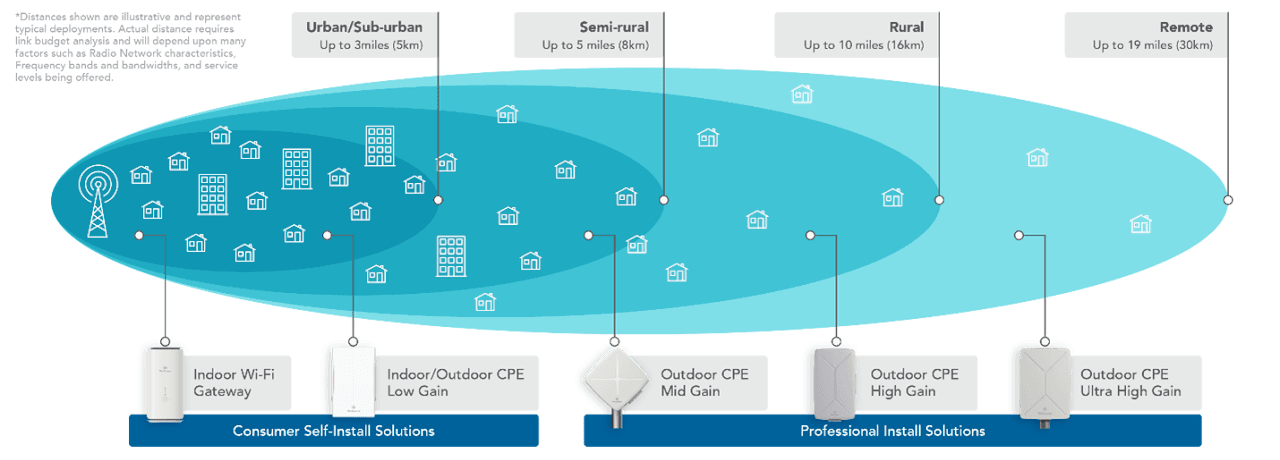
Ready to boost your connectivity? Explore our innovative Fixed Wireless Access solutions, designed for high-performance across urban, suburban, and even remote rural environments.